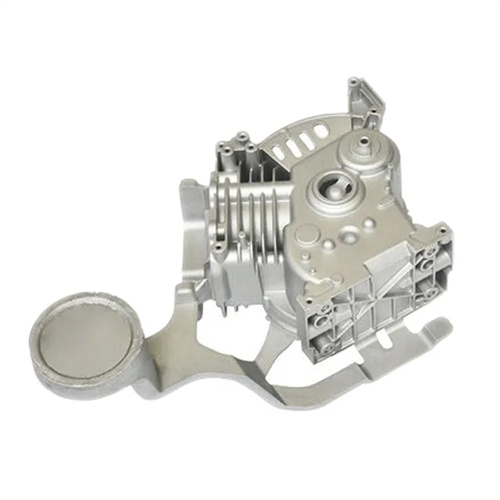
Layout of multi-cavity runners in die casting molds
The layout of multi-cavity runners in die-casting molds is key to ensuring uniform molten metal filling in each cavity and consistent casting quality. Its core goal is to ensure that molten metal enters each cavity at similar pressures and velocities within the same timeframe through rational path planning, thereby minimizing problems such as dimensional deviations and defect rates in castings caused by uneven flow distribution. Multi-cavity layouts require comprehensive consideration of the number of cavities, their arrangement, spacing, and the flow characteristics of the molten metal. Common layouts include symmetrical, asymmetrical, hub-and-spoke, and branching types, each with its own applicable scenarios and design considerations.
The symmetrical layout is one of the most widely used forms of multi-cavity runners. With the main runner as the central axis, the cavities and runners are symmetrically distributed on both sides, ensuring that the length, cross-sectional dimensions, and bending angles of each branch runner are exactly the same. This layout can minimize differences in molten metal flow and is suitable for castings with an even number of cavities (such as 2, 4, or 6) and identical structures, such as small gears, connectors, and other mass-produced parts. During design, the axis of symmetry must coincide with the centerline of the main runner, and the turn of the runner must use a rounded transition (radius of not less than 5mm) to avoid pressure loss and eddy currents caused by right angles or sharp angles. At the same time, the distance from the connection point of each cavity to the runner to the main runner must be strictly equal, with an error controlled within 0.1mm, to ensure that the time difference in the molten metal reaching each cavity does not exceed 5%, thereby ensuring the dimensional accuracy and mechanical property consistency of the casting.
An asymmetric layout is suitable for molds with an odd number of cavities or differing cavity structures. By adjusting the cross-sectional dimensions and length of the runner, flow deviations caused by the asymmetric layout can be compensated. For example, in a mold with three or five cavities, the cavities closest to the main runner can have a smaller cross-sectional runner (e.g., a 10%-15% reduction in width), while the cavities farther from the main runner can have a larger cross-sectional runner. This achieves flow balance by altering flow resistance. The design difficulty of an asymmetric layout lies in accurately calculating the pressure loss in each branch. This requires incorporating fluid mechanics principles and adopting the principle of “short runners with small cross-sectional areas, long runners with large cross-sectional areas.” Overflow troughs are also provided at the ends of the runners to absorb excess metal and gas. Furthermore, an asymmetric layout requires filling process analysis using simulation software to ensure that the filling time differences between cavities are within acceptable limits (generally no more than 10%). If necessary, the runner dimensions can be adjusted through trial molds until quality requirements are met.
The hub-and-spoke layout uses the sprue as the center, with runners extending radially outward to connect the various cavities. This layout is suitable for molds with circular or annular cavities, such as disc-like parts like bearing sleeves and gaskets. The advantage of this layout is a short and uniform molten metal flow path, with similar distances from each cavity to the sprue, resulting in minimal pressure loss. During design, the radial runners should have uniform angles (e.g., a 90° angle for four cavities and a 60° angle for six cavities), with cross-sectional dimensions gradually decreasing from the center to the ends (e.g., a 0.5mm decrease in width for every 10mm of extension) to accommodate decreasing flow rates. Runners in a hub-and-spoke layout should have circular or U-shaped cross-sections to reduce flow resistance. A small slag bag should be installed at the junction of each runner and cavity to filter impurities from the molten metal and prevent them from affecting casting quality. For larger diameter molds, reinforcing ribs should be installed between the radial runners to enhance mold rigidity and prevent deformation caused by excessive pressure during the die-casting process.
The branching layout utilizes a multi-level structure of a main runner and branch runners to distribute flow across multiple cavities. This layout is suitable for molds with a large number of cavities (e.g., eight or more) and complex arrangements, such as multi-cavity molds for small electrical components. The main runner extends from the main runner, with branch runners connecting each group of cavities at appropriate locations, forming a “trunk-branch” structure. During design, the main runner’s cross-section should be sufficiently large (e.g., 15mm-25mm wide and 10mm-15mm high) to ensure sufficient molten metal supply to each branch. The branch runner dimensions are determined by the number of cavities they connect. For branches connecting two or three cavities, a width of 8mm-12mm and a height of 5mm-8mm are recommended. In a branching layout, the branches should be evenly spaced (generally no less than 20mm) to prevent interference between the molten metal at the diversion points. A large overflow trough should be installed at the end of the main runner to prevent overflow caused by excessive molten metal supply.
The layout of multi-cavity runners also needs to consider the overall size of the mold and the parameters of the die-casting machine to ensure that the layout is compact and meets the equipment specifications. The total length of the runner should be shortened as much as possible, generally not exceeding 300mm, to reduce heat loss and pressure decay of the molten metal; the spacing between each cavity must meet the mold strength requirements (generally not less than 15mm), and at the same time facilitate the installation of cooling water channels and ejection mechanisms. In addition, the layout design needs to reserve space for subsequent cleaning and maintenance, such as setting a structure at the end of the runner to facilitate the removal of agglomerates, or reserving maintenance channels at complex turns. By comprehensively applying the above layout principles and design techniques, efficient and stable production of multi-cavity die-casting molds can be achieved, ensuring the consistency of casting quality and maximizing production efficiency.